
01
Applications & Common Challenges
- For components, PCB, precision cleaning, solution preparation and processes controlling ions, particles or organics.
- Conductivity alone is rarely enough; silica, boron, TOC, particles and microbial limits may change the process and budget.
- Distributed points of use, peak flow and restart recovery affect storage and recirculation design.
02
Information Needed Before Design
- Feed source and full analysis, seasonal variation and existing pretreatment.
- Hourly/daily demand, peak flow, duty hours, redundancy and expansion allowance.
- Targets at each point of use: conductivity/resistivity plus any silica, boron, TOC, particle or microbial limits.
- Space, materials, preferred brands, automation, temperature and distribution-loop requirements.
03
Typical Process Logic
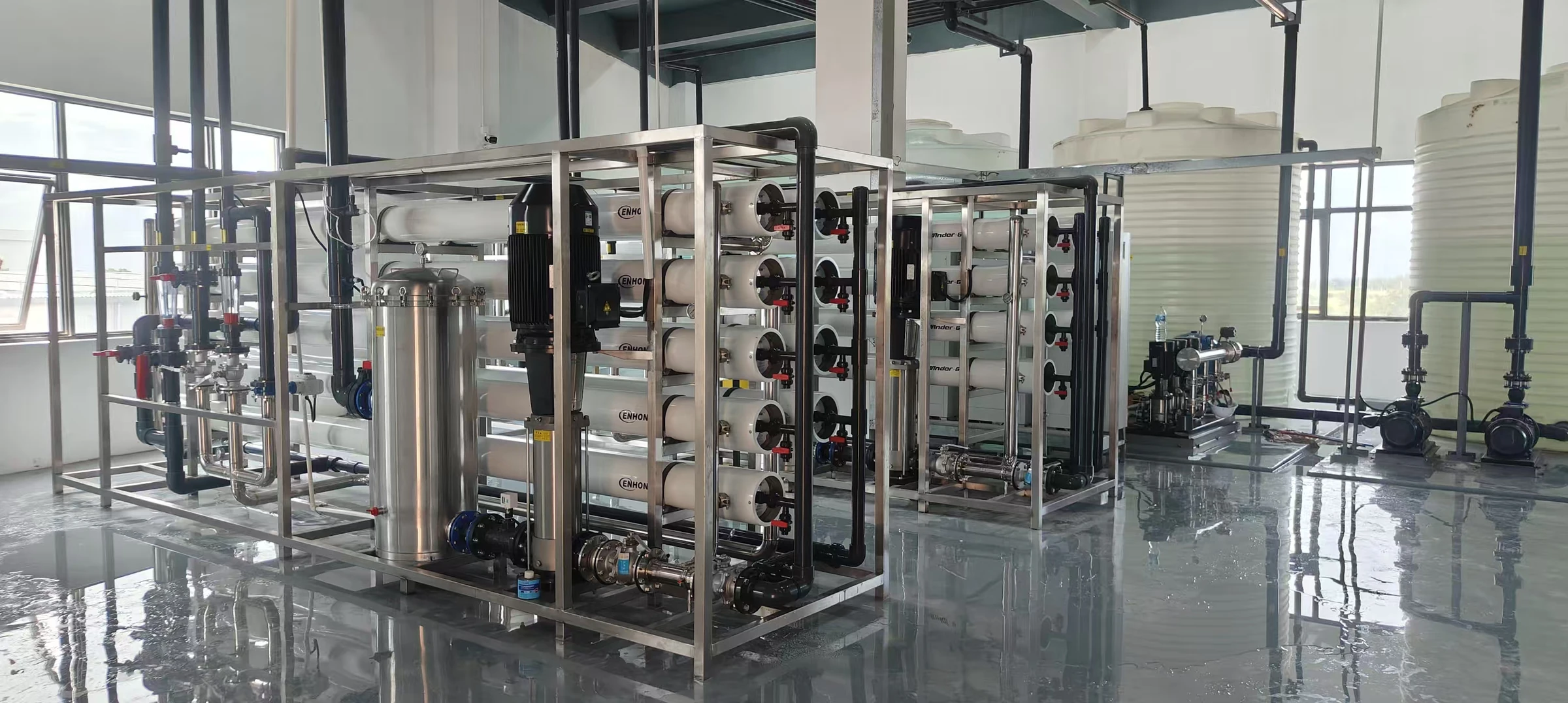
- Feed tank & boosting → media/carbon filtration or UF → cartridge filtration → one/two-pass RO → EDI or ion-exchange polishing → storage & recirculation.
- Two-pass RO, EDI, degassing, UV and final filtration are selected from actual inputs, not from the industry name alone.
04
Instrumentation & Control
- Monitor flow, pressure, temperature, conductivity, level and critical differential pressure; add resistivity, TOC or particle monitoring where required.
- Interlock low level, low/high pressure, pump/valve status and off-spec water; alarms and trends depend on operating needs.
05
Risks & Project Boundaries
- RO recovery must balance scaling, cleaning frequency and concentrate disposal.
- EDI requires controlled feed quality; clearly define whether storage, distribution and points of use are in scope.
- Put acceptance values, methods, sampling points, test duration and consumable brands in the technical agreement.