
Stable RO permeate is normally used as EDI feedwater
03 / ELECTRODEIONIZATION
EDI Ultrapure Water System
Ion-exchange resin, selective ion membranes and a DC electric field continuously polish RO permeate, reducing routine acid/alkali regeneration associated with conventional mixed beds.
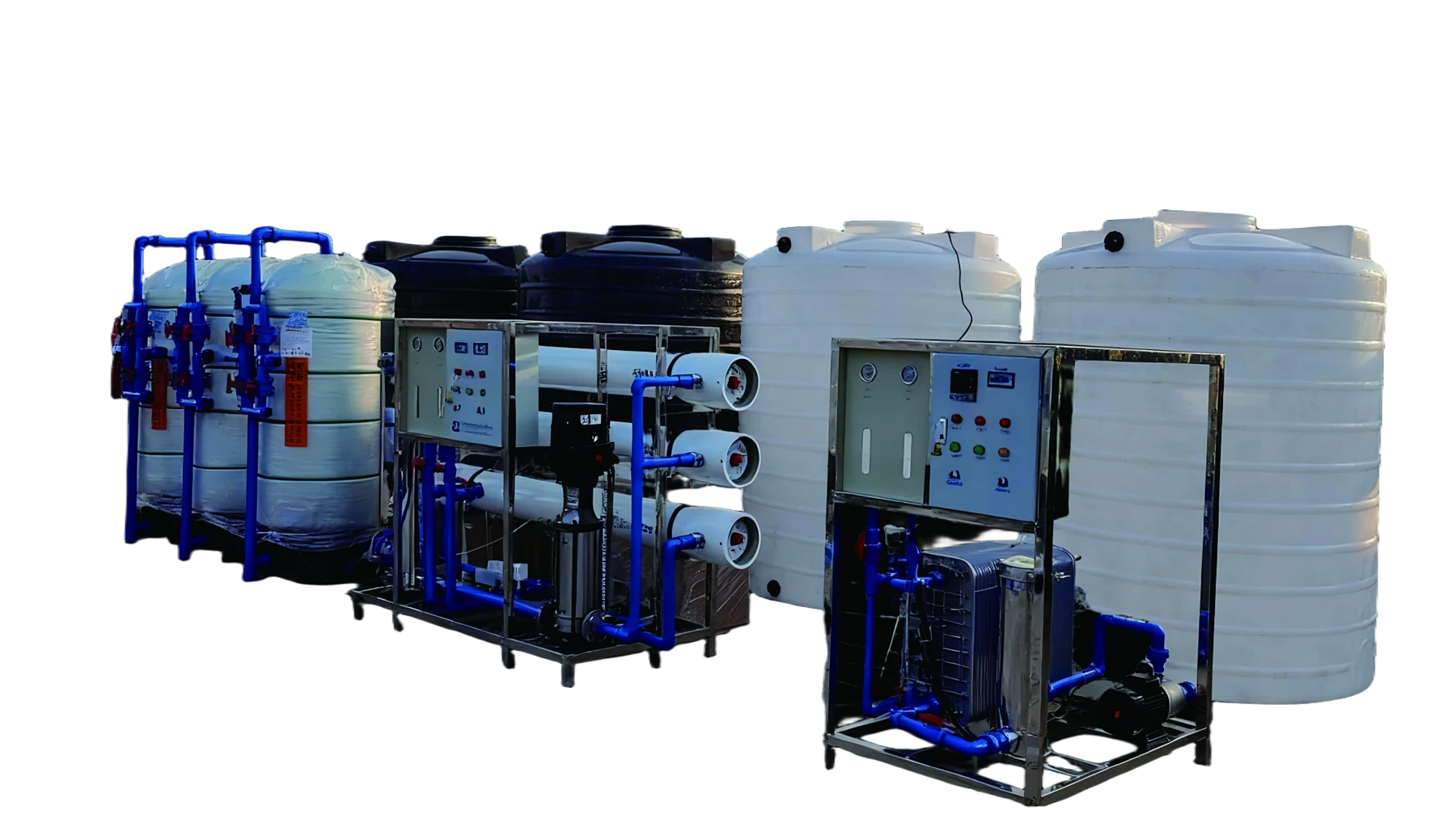
Resin is continuously regenerated under the electric field
Subject to module, feedwater and specified operating conditions
PROCESS ROUTE
Typical Process Route
This is a typical configuration logic, not a fixed equipment list. The final design depends on feed analysis, target requirements, capacity and site constraints.
- 01
Pretreatment
Softening and filtration with oxidant control
- 02
RO Desalination
Remove most dissolved salts and organics
- 03
CO₂ Control
Degassing or pH adjustment when required
- 04
EDI Polishing
Ion migration enables continuous deep deionization
- 05
Final Polishing
UV, final filtration or circulation according to use
APPLICATIONS
Applications
Electronics & SemiconductorHigh-purity process and rinse water
Photovoltaics & New EnergyBattery and material manufacturing water
Pharmaceutical EngineeringPurified-water related applications
Power & BoilerHigh-purity make-up water
Precision ManufacturingParts cleaning and formulation
Laboratory & TestingStable high-purity water supply
TECHNICAL KNOWLEDGE
Technical Notes & FAQ
Clear principles, prerequisites and operating limits help determine whether a process is suitable before quotation.
Why is EDI normally installed after RO?
EDI is designed to polish RO permeate with a low ionic load. RO first removes most salts and organics, allowing stable EDI operation.
Is feed conductivity alone sufficient?
No. Carbon dioxide, silica, hardness and total exchangeable anion load must also be assessed because conductivity does not represent every weak electrolyte.
Does EDI eliminate all chemicals?
The EDI module avoids routine acid/alkali regeneration, but RO cleaning, pretreatment and disinfection may still use chemicals.
Is 18 MΩ·cm always guaranteed?
It is a published upper performance level for certain commercial modules under specified conditions, not a fixed guarantee for every project.
Technical reference: DuPont electrodeionization principles and EDI-310 public product data. The 18 MΩ·cm value applies to specified modules and conditions; project performance depends on feedwater and final selection.
ENGINEERING DELIVERY
Engineering Delivery & Support
We support the full project lifecycle from process planning and manufacturing to commissioning and after-sales service.
Process Design
Define the process route and equipment selection from water quality, capacity, targets and site constraints.
Manufacturing
Modular assembly, quality inspection and factory testing against the approved design.
Installation & Commissioning
Site installation, integrated commissioning, operating optimization and operator training.
After-Sales Support
Ongoing technical support, consumables and troubleshooting, with a 24-hour response to after-sales issues.
START YOUR PROJECT