
01
Applications & Common Challenges
- For beverage preparation, food processing, product-contact water, container washing, CIP makeup and separately assessed boiler or cooling makeup.
- Quality targets, temperature, peak demand and hygienic risk differ by point of use; one specification rarely fits the whole plant.
- Microbial risk often arises from tanks, distribution, stagnation and endpoints—not only from the water-treatment skid.
02
Information Needed Before Design
- Feed source and tests for turbidity, hardness, alkalinity, TDS, residual chlorine, organics and microbiology.
- Purpose, hourly/daily demand, peak flow, duty hours, redundancy and expansion for each use point.
- Product standard, recipe or cleaning/sanitation requirements, plus materials, temperature and CIP/hot-water/chemical-sanitation conditions.
- Requirements for tanks, loops, drainability, sampling points, room hygiene and maintenance access.
03
Typical Process Logic
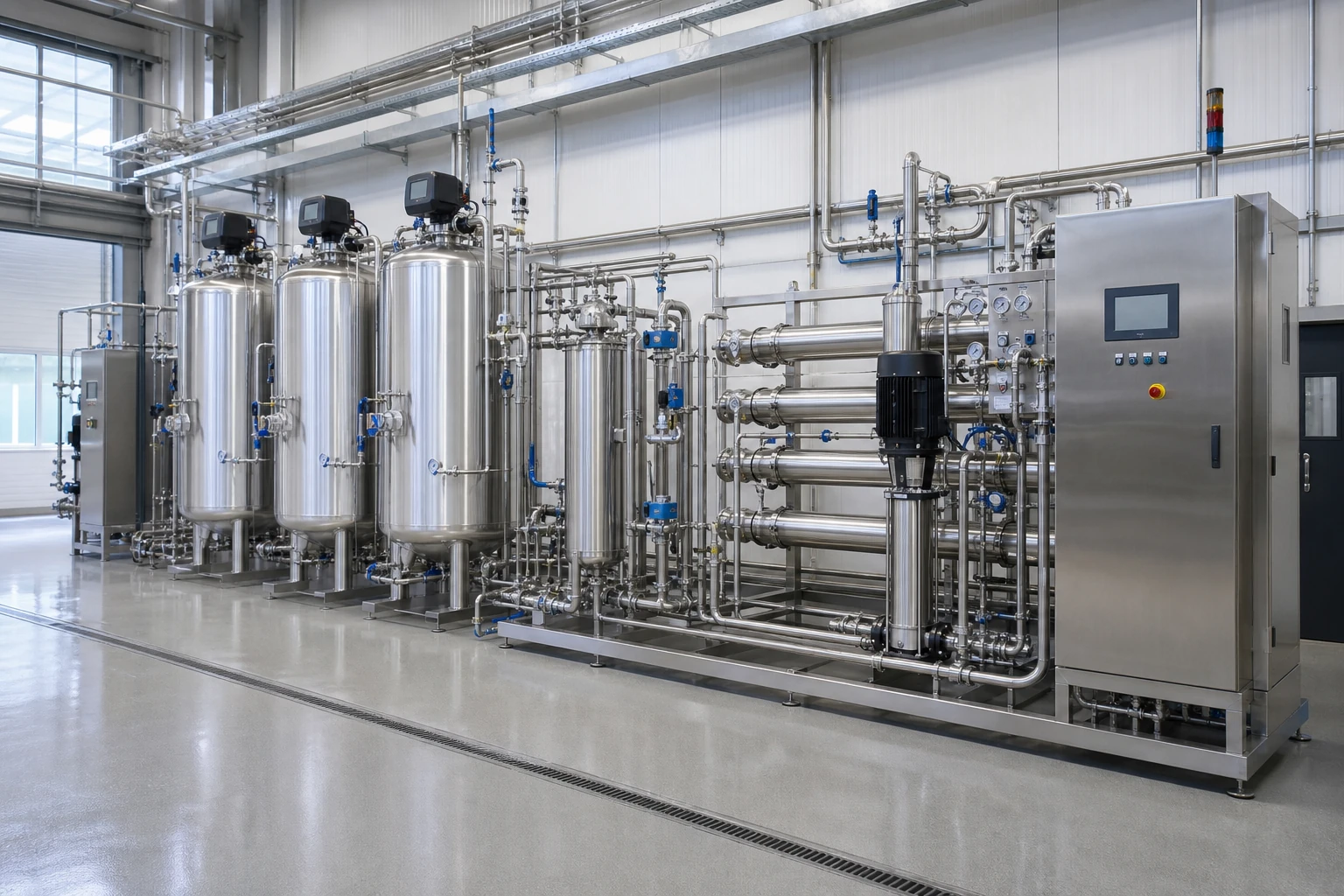
- Feed tank & boosting → media/carbon filtration or UF as justified → softening or antiscalant → cartridge filtration → RO/NF as required → UV, ozone or final filtration as required → hygienic storage & distribution.
- Not every food process needs RO, and some products require controlled mineral content. Select the final route from use, product requirements and water-quality risk.
04
Instrumentation & Control
- Monitor flow, pressure, differential pressure, temperature, level, conductivity and turbidity; monitor dose, UV intensity or residual where applicable.
- Hygienic design should prioritize drainability, fewer dead legs and stagnant zones, sensible sampling points, sanitation procedures and records—not simply more instruments.
05
Risks & Project Boundaries
- GB 5749 can be one drinking-water hygiene baseline, while product-contact water and production hygiene still depend on product-specific, company and regulatory requirements.
- Specify material certificates, consumables, sanitation, microbiological sampling, acceptance duration and storage/distribution boundaries.
- This page does not promise a fixed product-water specification; the final design follows feed data, use, risk review and contract.