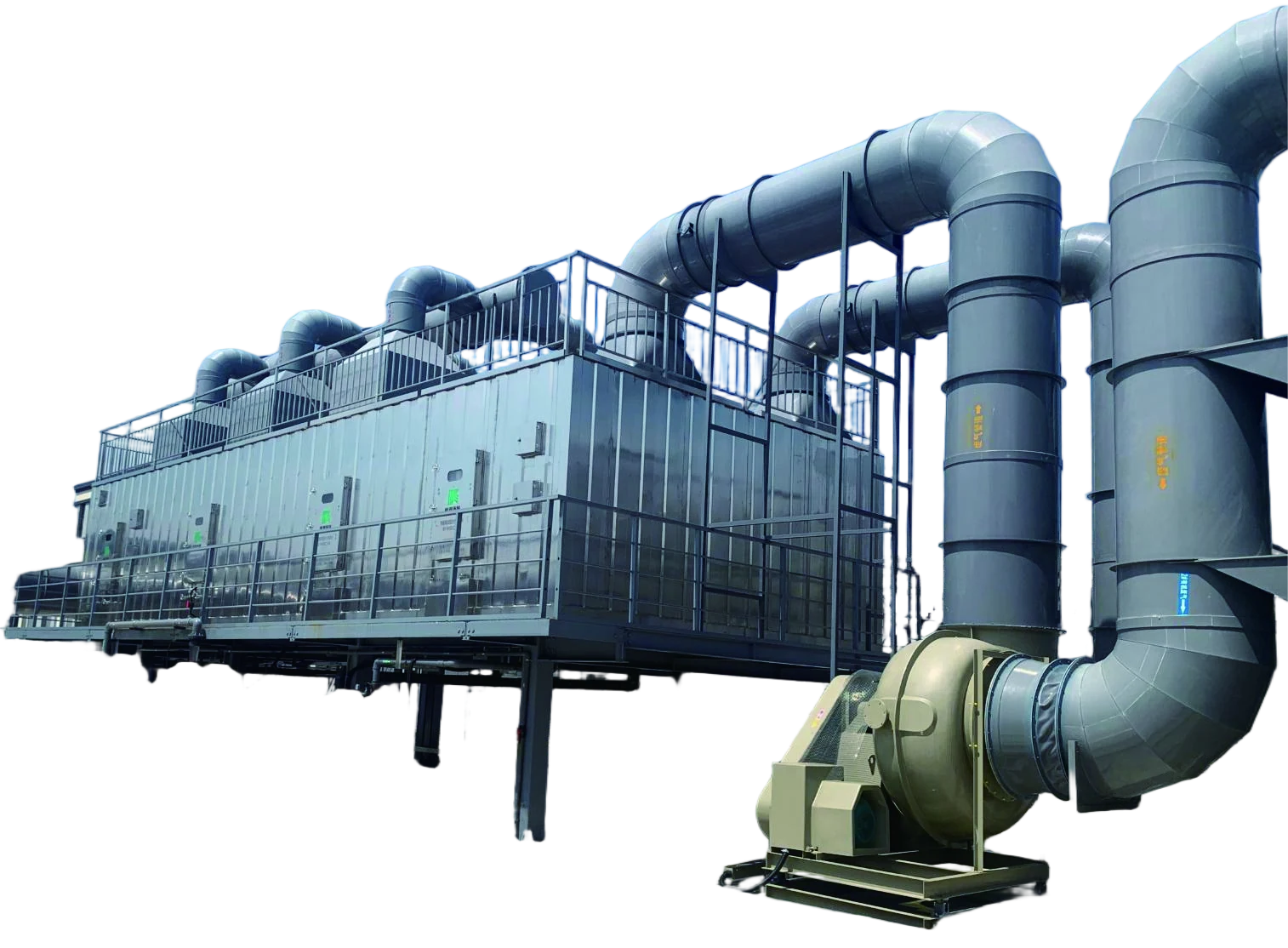
Hoods and ductwork determine whether pollutants reach the unit
10 / WASTE GAS
Industrial Exhaust-Gas Treatment Equipment
Scrubbing, adsorption and filtration units are configured for acidic or alkaline gases, VOCs, particulates and odour.
Acid gas, dust and VOCs require different mechanisms
Trends indicate blockage, reagent use and absorption condition
PROCESS ROUTE
Typical Process Route
This is a typical configuration logic, not a fixed equipment list. The final design depends on feed analysis, target requirements, capacity and site constraints.
- 01
Source Capture
Enclose or locally capture fugitive emissions
- 02
Duct Transport
Balance branches and provide inspection access
- 03
Pretreatment
Cool, remove dust or condition humidity
- 04
Main Treatment
Scrub, filter or adsorb according to pollutants
- 05
Fan & Discharge
Monitor pressure, liquor and outlet condition
APPLICATIONS
Applications
Acid/Alkali GasScrubbing and mist elimination
VOCsPretreatment plus adsorption or combined treatment
Dust & ParticulatesFiltration, washing or collection
Electroplating LinesSide capture and branch balancing
Odour ControlSelect absorption or adsorption by composition
Chemicals & MaterialsCorrosion-resistant and safety-led design
TECHNICAL KNOWLEDGE
Technical Notes & FAQ
Clear principles, prerequisites and operating limits help determine whether a process is suitable before quotation.
Why is a scrubber alone not a complete solution?
Poor hood capture, duct leakage or unbalanced branches keep pollutants from reaching the equipment. Capture, resistance, fan pressure and the stack are part of one system.
What should be monitored on a scrubber?
Circulating-liquid pH, level, spray rate, packing, mist-eliminator pressure and blowdown. A running pump alone does not prove treatment performance.
When should activated carbon be replaced?
The interval depends on VOC composition, loading, airflow, humidity, temperature, pretreatment and bed mass. Use pressure and outlet monitoring or adsorption loading, not only a calendar.
Is more airflow always better?
Too little reduces capture; too much wastes energy and changes gas-liquid contact. The design balances hood control velocity, branch flow and leakage.
Engineering boundary: Process and materials follow pollutant composition, concentration, temperature, humidity, airflow and safety requirements.
ENGINEERING DELIVERY
Engineering Delivery & Support
We support the full project lifecycle from process planning and manufacturing to commissioning and after-sales service.
Process Design
Define the process route and equipment selection from water quality, capacity, targets and site constraints.
Manufacturing
Modular assembly, quality inspection and factory testing against the approved design.
Installation & Commissioning
Site installation, integrated commissioning, operating optimization and operator training.
After-Sales Support
Ongoing technical support, consumables and troubleshooting, with a 24-hour response to after-sales issues.
START YOUR PROJECT